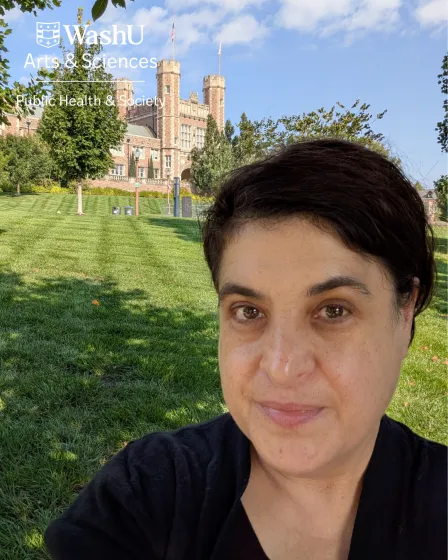
Meet Prof. Chen Reis, faculty member with Public Health & Society.
Tell us a little bit about yourself. Where did you go to school and what did you study?
I went to Johns Hopkins for my undergraduate degree in anthropology. I also have a law degree, an MPH and a PhD. The law degree was from Columbia, the MPH was also from Hopkins, and the PhD was from University of New South Wales in Australia.
My area of specialization is gender-based violence in humanitarian settings. As I studied more and as I worked in different places, it just became clear to me that public health was the right lens for what I was interested in; the systems thinking of public health resonated with me.
When I was studying law, there was a lot of focus on child soldiers, specifically boys who were being recruited to fight in various armed groups. But there was very little focus on what was going on with girls, whether they were scooped up by armed forces or just living through conflict. I became interested in looking at the violence that they experienced and the ways in which they became more vulnerable to certain forms of abuse, whether in the community or in these armed groups.
Can you tell us about the public health work that you did before you came to WashU?
Prior to coming to WashU, I had a few different jobs. I worked with Physicians for Human Rights researching gender-based violence, health, and human rights in Sierra Leone during the conflict. I also worked on HIV and AIDS research in Southern and West Africa, researching the ways in which people who had HIV or were suspected of being HIV positive were discriminated against by the healthcare sector. That was public health work, but it was very much research and advocacy focused.
I then moved to the World Health Organization (WHO), where I was involved in a mixture of policy and advocacy. My first role there was to help establish the Sexual Violence Research Initiative which was originally project hosted by the World Health Organization but is now its own organization. I then worked for the humanitarian health part of the organization.
I kept seeing in my work that although the humanitarian organizations were trying to fill gaps during conflict times, there were still a lot of gaps remaining around gender-based violence. I heard excuses like, oh, we don't really know what we're doing or it's too new of an area for us or we don't have the resources. When I was leaving WHO and about to head to the University of Denver where I took a teaching position, I thought to myself, I want to do a PhD on this. I expanded my research on the gaps in gender-based violence service provision through the health care sector in emergencies and also looked at issues with the ways in which there were barriers both to receiving care and providing care.
Can you share some insights from the research project that you're working on now?
I am writing a book based on my research and there are two interesting components. First, the humanitarian sector did best when it restarted services that already existed before the conflict. They were basically providing people who were already trained with additional support, like materials or space to work. But clinical management of post-rape medical care is not embedded in preclinical education in most of the world. If it is available, it's available as an elective. So instead of helping restart a service, you're trying to start it from scratch. It's difficult to train people in the context of a conflict because they're already overstretched or they're working in suboptimal conditions. The humanitarian system is not particularly well suited for it.
I think the other interesting thing is the evolution of the way in which the humanitarian system addressed gender-based violence. In the mid-1990s, they brought in elements from social work practice around domestic violence or intimate partner violence where the focus was very much survivor-centered care. They would let the survivor say what they needed and then wrap the services around the survivor. However, in emergency settings, what you're saying is: “This is what we can offer. Tell us what you want from these options.” It's not survivor-centered care. Truly survivor-centered care would require a radical reconfiguration where the humanitarian system responds to the needs and wants of the survivors and their communities.
Do you have a favorite public health book?
One of my early favorites is a book called The Cuba Commission Report. It was written in the late 1800s, this was after the end of African enslavement, when the plantation owners in the Caribbean looked for other sources of labor that they could exploit. They were able to go to China and falsely promise things to Chinese workers, bring them over, but actually cheat and abuse them. There are testimonials in the report from the actual people affected. You get to see how these bigger forces of history such as globalization, and colonialization affected individuals.
What advice would you give students who are just beginning their public health journey?
Take time to figure out how you're going to balance your work and your life. In this work, there are a lot of setbacks and it's not always so easy to see the immediate impact of what you're doing. You need to figure out a way to carve out time to do things that are important to you, to be in community, to let your mind rest. Set boundaries early on and when you go into your work life, bring that with you. It is easy to become hyper-focused on work and lose track of other things that matter.