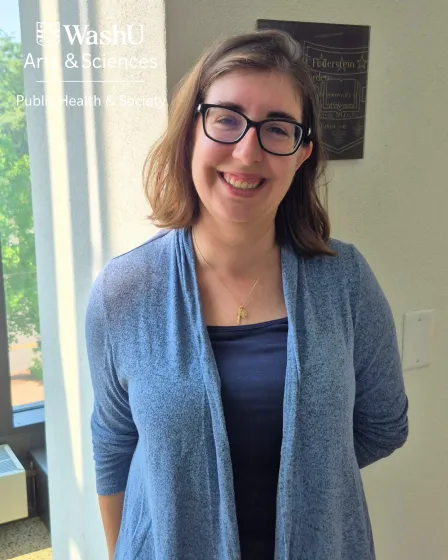
Meet Prof. Kristin Brig-Ortiz, now the Director of Undergraduate Studies for Public Health & Society.
Where did you go to school and what did you study?
I am a historian of environmental health in Southern Africa. I did my bachelor's and master’s in history, both of which I did at the College of Charleston in Charleston, South Carolina. And then I did my PhD in the history of medicine, science and technology at Johns Hopkins. I'm currently working on a book manuscript about water management and urban public health in the 19th century, Cape Colony and Natal, which today would roughly equate to the Western and Eastern Cape and KwaZulu-Natal in South Africa. I'm thinking about how public health knowledge becomes co-constructed between what we think of as top-down officials and from the lay public from the bottom up.
What sparked your interest in the history of public health?
I grew up around medicine and a lot of public health concerns. My dad’s a Hematologist Oncologist, and he had a bunch of these old medical textbooks. I'd open them up and look at pictures of lesions and cancerous organs and stuff that probably wasn’t appropriate for a five-year-old. Then, when I was a bit older, I had a bad reaction to penicillin and to a Z-Pac (azithromycin). After that, my parents said, “No more antibiotics, but you need to get your flu shot every year, just in case this turns into pneumonia.” So, medicine and public health were following me throughout my life.
Because of these influences, I naturally moved into the history of medicine for my master’s thesis. While doing thesis research, I found an interesting anecdote about smallpox vaccination in the British military in the 1880’s that led me to questions about how vaccination was implemented in South Africa: how public health more broadly was administered, and why people were questioning what public health officials were saying.
Can you share some insights from your recent research and travels?
Oh, I have lots. I'm more than happy to talk about the reference to sparkling water from a well near a grave site that I found. That was not great.
When we think about public health and medicine more broadly, we're often thinking about authorities such as the CDC, the WHO, NIH, and these big organizations that employ lots of people. But what I'm finding from my research is that public health is often co-constructed with insights and knowledge from the communities that public health workers are serving.
Also, in the 19th century and early 20th century, in order to secure disease prevention, public health officials tried to regulate everything that they possibly could, especially in colonial sites. They tried to regulate every space, technology, and behavior. This is a period in which there were many different public health theories and medical theories coming to the surface such as sanitary theory and germ theory. Public health officials suddenly had a lot more tools that they could use. They used those tools to try to make society as “clean” as possible. As you can probably imagine, they received a lot of pushback from communities themselves in the process.
Congratulations on becoming Director of Undergraduate Studies. What does this new role mean to you?
Broadly speaking, it means working more closely with students, faculty, and staff to shape this super innovative program. I'm excited about making even more space for students to explore various pathways with our electives and core courses that meet their interests and goals, especially in health-related careers.
Do you have a favorite book on the history of public health?
I have so many books that I can recommend! The two that come to mind are Epidemic Invasions by Mariola Espinosa and Contesting Space in Colonial Singapore by Brenda Yeoh. Epidemic Invasions has to do with yellow fever control in the US empire, focusing on Cuba and Panama. Espinosa explores what American imperial public health officials did and how affected communities responded to those interventions, especially in the 19th and early 20th centuries. I like Yeoh's book as well because, instead of focusing on one disease, she's focusing on one place, British-controlled colonial Singapore, and thinking about all the different spaces where public health was involved. She thinks about water management and infrastructure. She thinks about burial grounds and their regulations. She thinks about architecture, overcrowding, and housing. There are tons of books on the history of public health that are my favorites, but those are two that have stuck out to me over the years.
What advice would you give to students who are just starting their public health journey?
First, follow your passions. When I say passions, that can mean something that you've been deeply interested in for a long time or a spark of interest from a course. When you're thinking about public health, you also want to be thinking about what am I passionate about helping people with? As you're moving down your public health pathway, keep communities and people at the forefront of your mind. What drives you to help people?
The other thing is to take a variety of courses. Public Health & Society is such a great program for this because we ask our students to take interdisciplinary courses. We require them to think about public health from different angles. I would suggest is trying to get a feel for as many different disciplines as possible so you get as full of context for public health as you possibly can.