In Foundations in Public Health, students from across WashU step into the world of public health practice and take on real-world challenges through the Public Health Policy, Practice, and Systems Change Labs (Applied Learning Labs), discovering how evidence, collaboration, and creative thinking can help address some of society's most pressing challenges.
Imagine being asked to advise the St. Louis Department of Health on a pressing community health concern. You have scientific evidence to interpret, competing priorities to weigh, and colleagues who may disagree on the best course of action. Your task is to develop a thoughtful recommendation and make a persuasive case for it.
Now imagine doing this in your very first public health course, and enjoying it, perhaps without ever having considered a career in the field.
At Washington University in St. Louis, experiences like this are part of PUBHLTHSOC 1000 - Foundations in Public Health, one of the first core requirements for Public Health & Society majors that also welcomes students from across the university.
Through the Public Health Policy, Practice, and Systems Change Labs, known as Applied Learning Labs, students step into simulated professional roles and discover what it means to put public health knowledge to work.
“A foundational course should give students more than the vocabulary of a discipline. It should invite them to experience how its ideas are used, how its questions are debated, and how evidence and thoughtful judgment can inform action and systems change,” says Ans Irfan, professor of practice in Public Health & Society and a co-instructor of the course.
For Ebube Okereke, a student and Public Health & Society Student Ambassador, that invitation became tangible during a lab exploring how public health professionals might prevent human papillomavirus (HPV). Her Learning Community had to consider what prevention actually requires: where to intervene, which approaches might reach the most people, and how to account for the conditions that influence health.
“The learning labs in my Intro to Public Health class help us apply what we read to real-world scenarios. In a recent lab, we used the architecture of prevention to work through how a public health professional would stop HPV before it starts. Hands-on courses like this give you real insight into the work you’d be doing in the field, and that makes me really excited to pursue it.”
The challenge looks different when the subject is extreme heat. Students are presented with proposed federal policies and asked to determine which deserve priority. They examine population health evidence, weigh competing policy goals, and consider how each proposal might alter the distribution of resources and power: who gains protection, who has influence over decisions, and who remains exposed. Some interventions may offer immediate relief; others seek to change the structural conditions that leave certain communities socially vulnerable to extreme heat in the first place.
Students first develop their own rankings, then work within their Learning Communities to reach a collective judgment. The exercise reveals how much careful reasoning is involved in making a recommendation that others can challenge.
For Mohammed Abba-Aji, MD, MPH, DrPH, a physician and population health scientist who co-instructs the course, the labs place students in situations involving “a real problem with real constraints,” inviting them to use epidemiological reasoning, equity, and systems thinking as practical tools.
“And we want them to have these tools from the outset, not at the end of the degree,” he says.
Different Perspectives, Shared Learning
The conversations are shaped as much by who is participating as by the problems themselves.
A student studying architecture might recognize how housing or neighborhood design affects health. Someone approaching the same concern through sociology may notice the influence of social institutions and inequality. A classmate interested in economics might ask whether a promising intervention can be sustained or who bears its costs.
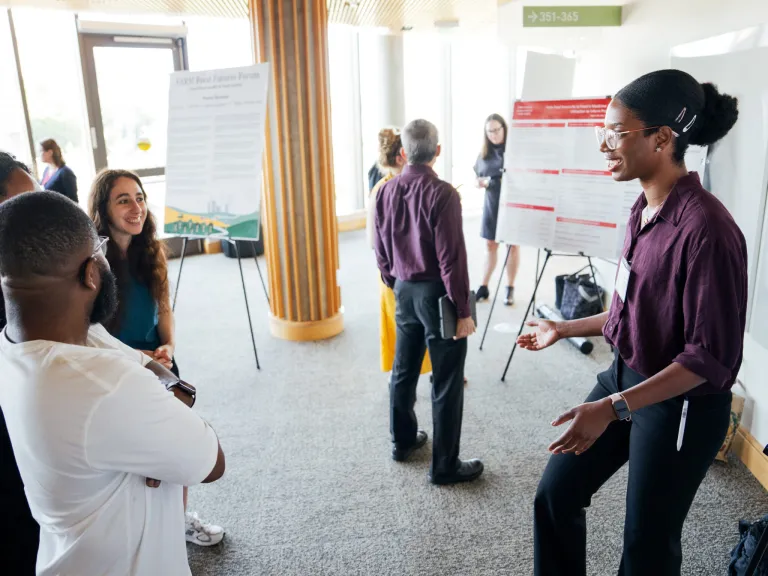
Within the larger introductory course, students meet in smaller, continuing Learning Communities led by teaching assistants to work through the Applied Learning Labs. These communities offer opportunities to develop their reasoning, wrestle with ideas, challenge assumptions, and refine thinking through sustained collaboration and exchange.
Carter Davidson knows the experience from both sides of the classroom. Having completed Foundations in Public Health himself, he now leads a Learning Community as an undergraduate teaching assistant.
“I have loved watching my students grow more comfortable sharing their opinions and strategies; everyone has their own perspective which builds on each other.”
For Jolaade Bada, another student and Public Health & Society Student Ambassador, the value of these exchanges became clear during an exercise in which her group identified an emerging health concern and developed prevention recommendations.
“Working within our immediate learning communities allowed us to develop and refine our knowledge of the lecture material, while the opportunity to share and hear from other learning communities exposed us to different perspectives.”
The richness of those conversations reflects the larger character of WashU's Public Health & Society program, a collaboration between Arts & Sciences and the Bursky School of Public Health. By bringing the humanities, social sciences, natural sciences, and professional public health practice into conversation, the program creates opportunities for students to discover connections that may be less apparent within a single discipline.
The work also remains connected to the university's home. In the In St. Louis, For St. Louis Health Equity Strategy Lab, students take on the simulated role of Public Health Equity Fellows, examining a local health concern and preparing an evidence-informed briefing for city health leadership. Their recommendations must account for the social and structural determinants of health, racial equity, and the practical realities of public health policy.
Dynamic Learning: The Freedom to Think, Question, and Discover
The teaching team reports that the labs have been enthusiastically received in midterm course evaluations. Students have also contributed thoughtful feedback that helps shape the experience as the semester unfolds.
“One area that I think improved over the course of the semester was the balance between lecture time and group discussion,” Bada observes.
For Irfan, recently inducted as a Principal Fellow of the United Kingdom's Higher Education Academy, such observations reflect a conviction that students should help shape the intellectual environment in which they learn. His approach draws on public health practice and learning science, including his recent coauthored publication, From Theory to Practice: Case Studies on Implementing Active Learning in Public Health Education.
Beyond Grade Anxiety: The Joy of Collaborative Learning
An important part of that approach concerns how academic achievement is understood. The labs are designed so that grades reflect thoughtful engagement with evidence and ideas, critical inquiry, creativity, and meaningful collaboration. Students can pursue academic excellence while enjoying the freedom to explore unfamiliar perspectives and develop their thinking alongside others.
“The purpose of education is not merely to impart knowledge, but to cultivate the intellectual curiosity, confidence, and judgment to put that knowledge to work transforming systems in service of human flourishing,” says Irfan.
“We want students to experience the intellectual satisfaction of working through difficult problems without feeling that every uncertainty or imperfect idea puts their academic success at risk. What matters is that they engage rigorously with ideas and evidence, challenge their assumptions, and learn generously from one another.”
For students entering public health from many different academic directions, the opportunity to exercise judgment, encounter new perspectives, and discover the pleasure of working through complexity offers something they can carry well beyond this introductory course.
Davidson captures that larger purpose in a question he hopes students will continue asking:
“These labs are precisely what I believe this class highlights and encourages; it asks the question, what can we all do to collaborate to create a healthier and more equitable society?”
It is a question with room for every discipline, and one that students in Foundations in Public Health are already learning to explore together.