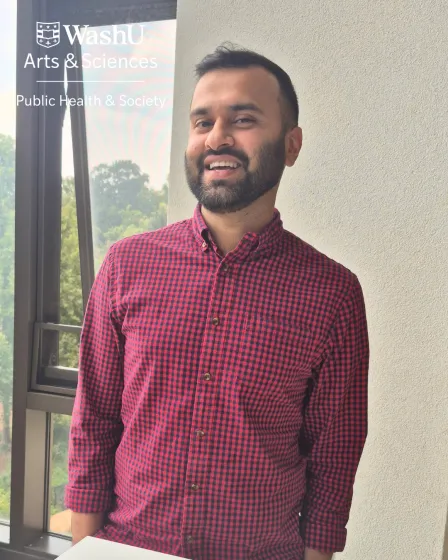
Introducing: Prof. Ans Irfan, a new faculty member in Public Health & Society.
Tell us about yourself. Where did you go to school and what did you study?
I am a physician by training. I went to med school because my parents told me to; I had no interest in clinical medicine. I grew up in a small village in the middle of nowhere, Pakistan, in a farming family. Retrospectively, a lot of my work is informed through that lens because there were challenges with water scarcity and so on that were driven by climate change. (Now I understand that it had something to do with climate change, back then I didn't.)
I've lived in Pakistan, China, Portugal, and in the US. I got my medical training in China at Xinjiang Medical University. I have a second doctorate in public health, global health systems, and climate adaptive global health systems from George Washington University. I have a third doctorate (because I love education) in education from Nebraska Methodist College. I have a fourth doctorate in information technology from Middle Georgia State University. I have an MPH, also from George Washington University. I have another master's degree in death, religion, and culture from University of Winchester in the United Kingdom. And I have another master's degree in religion and public life from Harvard University.
What made you interested in public health?
I had been doing public health-related work without knowing it was public health. Be it in workers' health specifically with farmworkers and pesticide safety, working with Afghan refugees on sexual health and condom negotiations, and then with LGBTQ and specifically trans health in Pakistan. Within clinical medicine, you can get instant gratification by prescribing medication, which you know will make this person feel better immediately. But you're not fixing any of the systems or the structures that caused that issue. Public health is the field that allows us to critique those structures, but ultimately, offer creative solutions on fixing the root causes. I've been a kid in a candy shop with public health ever since and much of my work from research has the common thread of public health equity and climate justice.
What drew you to Public Health & Society?
As someone who had most of their training in STEM sciences and that mechanistic way of looking at things, I've come to embrace humanities and see their value as critical to moving past the status quo. This program is merging the two. It's going to give students this critical way of looking at things beyond the purely mechanistic approaches that have failed us. I don't have to put in extra effort to ask people to create a learning ecosystem that would merge humanities and public health. It's already doing it!
Do you have a favorite public health book?
I’m reading/re-reading all of these at the same time, so I have three. The first one is The Viral Underclass by Steven Thrasher. I think it's a wonderful book. In the US, we talk about critical thinking a lot, but very few people actually engage with it beyond the buzzword or the confines of ruling class permissibility. And I think that he's an author who does do an excellent job at it. The book talks about HIV history and COVID-19 and all the inequities that came into it. How the social structures and systems informed what we did or did not do and who we failed, why we failed. I think it's a good critical analysis, some of which I don't even agree with, but I think it's a refreshing insight.
The second book he just wrote, which I've just started, is called The Overseer Class. It's another remarkable book. It critiques the notion of representation as the be-all and end-all. The current liberal paradigm, the prevailing assumption of academic institutions as well, is that representation itself is sufficient to transform systems and structures. The notion that just because we are going to get X type of people in whatever field, that's going to fix things. But it doesn't implicate class or structural racism and representation without structural change or accountability can and does reproduce the same hierarchies and health inequities. I have just started it, but I think that it takes the approach that representation is necessary but insufficient.
The final book is Enshittification. With our apps and technology, over the years, the services get degraded and prices go up after hooking the public on them. Even though the book is written on tech, the thesis itself has a lot of transferability to other things all around us. So that's another book I would highly recommend for students to check out.
What can students expect from you as a professor?
I'm less interested in telling them what to think but rather giving them tools on how to think. We don't have to agree on anything, but we need to develop our mental models to wrestle with bigger questions about how the world should look in the future. In my classes, they will find no busywork; only an intentional effort to weave together joy, creativity (both of which I see as essential as any other aspect of the learning process), and real-world skill building, without compromising academic rigor. Of course, my ulterior motive is that one of these days in the future, they're going to be on CNN or BBC, and I get to show off that that was my student.
What advice would you give to students just beginning their public health journey?
They should reject the cynicism around public health that is prevailing at the moment. Public health is truly one of the most interdisciplinary fields. The skill set that we cover in public health is applicable to a wide range of other disciplines. These are transferable skills. Public health trains you from communication to leadership to health equity to systems thinking and structural analysis. The skills they gain in that process are beyond the scope of what AI can do, which makes public health particularly valuable in this moment (so beyond being a moral agent, you get to have better job prospects). That level of uniquely inter and transdisciplinary skill set is not true for just about any other field. I observe that without dismissal, and as someone who has dabbled with multiple of those, I think I can say that with some degree of confidence. Finally, I hope they know that the systems we inherit are not laws of nature. Social and health inequities are policy choices, choices made by people. We can choose differently to build a better world, and public health will give them the tools to do just that.