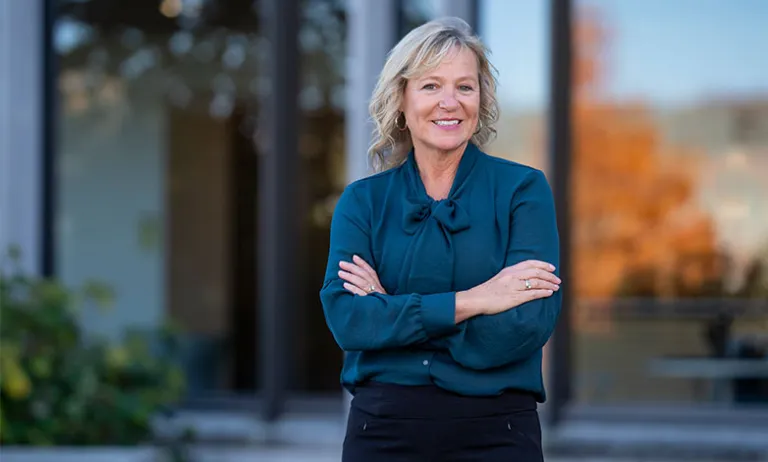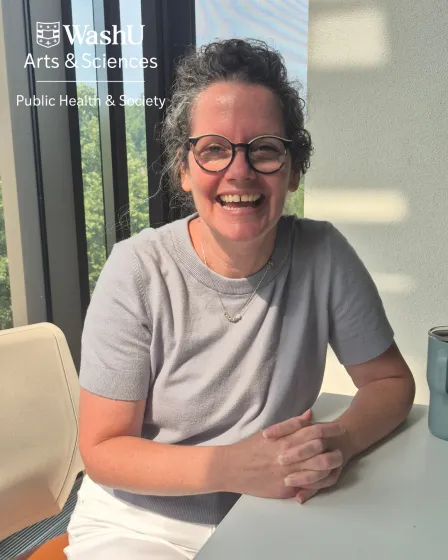
Introducing Prof. Bree Bode, a new faculty member in Public Health & Society.
Where did you go to school, and what did you study?
I studied at Wayne State University to earn my PhD, concentrating on community health. I focused on how we can improve environments where people eat or buy their food. That could be a school lunchroom, grocery store, or a corner store.
Prior to that, I studied at Grand Valley State University. I got a Master's in Public Health with a concentration in health education and promotion. I also completed my bachelor's degree there, Bachelor's of Science in Physical Education with a concentration in corporate fitness and wellness. I also had a stint at community college; I was a non-traditional student for most of my academic trajectory.
What got you first interested in public health?
I didn't know that what I was doing was public health. I had been working in a clinical setting for approximately 10 years and was interested in physical and occupational therapy. So, one day I went to Grand Valley State University and listened to all the things that are required to enter the occupational therapy program because I thought I was going to go in that direction. And while I was there, somebody said, “Have you heard of public health? We're doing an orientation session on that today.” And I said, “No, but I'm here.” After listening to that orientation, I thought, this is exactly what I've been looking for. This represents me and how I think and how I want to maneuver within the world.
As I became more educated in the field of nutrition, I could never see school meals or the grocery store the same ever again.
Can you tell us about the public health work you did before coming to WashU?
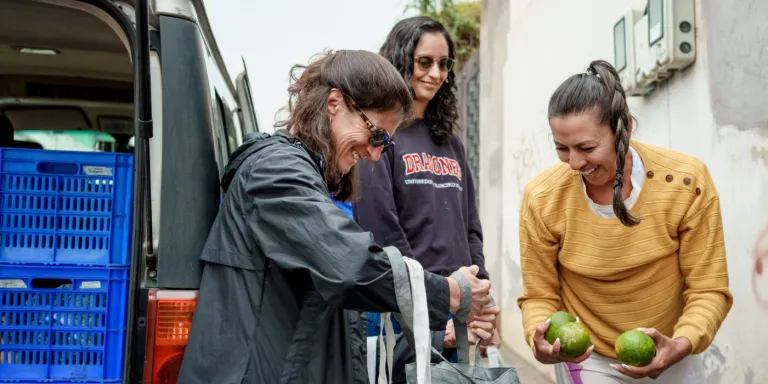
The main body of my work was looking at how statewide implementation of nutrition education and physical activity interventions, including those related to policy, systems, and environmental change, were producing health promoting outcomes through what was known as SNAP-Ed. That was just a beautiful body of work where I was able to support community-based organizations who may not have had the capacity to develop evaluation plans and then conduct outcome evaluations on their own. Multiple community organizations across the state of Michigan were using the same tools to measure interventions. For example, three interventions focused on retail environments like restaurants, corner stores, farmers markets, or community supported agriculture sites where shoppers could go and spend their SNAP dollars and at the same time get nutrition education. We would measure the shoppers' short-term and medium-term outcomes as to whether or not their engagement with a nutrition educator assisted them in repeating that vegetable consumption behavior over time. We also measured if small “p” policy, systems, or environmental changes were adopted and the ways those changes influenced shoppers and even staff. The evidence suggested SNAP-Ed was a vital component of driving positive changes in people and communities. These studies are all submitted for peer review right now.
Outside of SNAP-Ed, most recently, I also worked on a multi-state research project that looked at the readiness of dollar stores to accept WIC. We trained a variety of data collectors: graduate students, undergraduate students, and even a retired community champion to collect the data. We went through the dollar stores to understand what products were on the shelf. Was there a substantial amount of healthy options versus ultra-processed options? Were there basic-needs products such as hand sanitizer or cleaning products? Were there vice products like tobacco and alcohol? I led a policy brief on this project that will be published in the coming months.
What drew you to Public Health & Society?
I first noticed the way that WashU and the public health program at large were really living the values that I wanted to be a part of. Even in the title Public Health & Society, is such a beautiful way to communicate what the program stands for. It's not just saying we care about public health, but we also care about society. I am very interested in being part of a community where we can transparently talk about things like the commercial determinants of health and how that's really an intersection of health and society.
Also, I have a soft spot for being with undergraduate students. Knowing what it meant for me to traverse my undergraduate degree as a non-traditional student and reflecting on all the support that it takes. I want to make sure that the students know that I'm here for them. And it's not only about teaching public health coursework. I'm hoping to be somebody that the students find approachable and reliable.
Do you have a favorite public health book, podcast, or documentary?
Anything by Marion Nestle is my favorite.
What advice would you give to students just beginning their public health journey?
- Be curious.
- Meet people.
- And keep a journal.
Keep a journal about the things that you're taking away from the course. As you approach each course, it isn't just about learning the material. Jot down what it was that made you feel inspired, made you feel invigorated, made you understand how you might be finding your purpose in the field. That's my advice.