As part of
National Public Health Week, the Public Health & Society
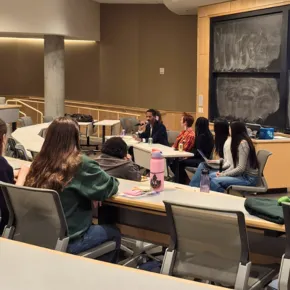
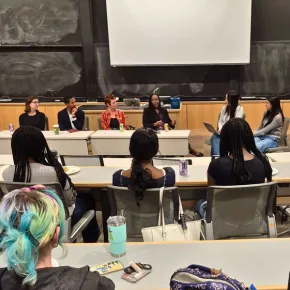
Student Ambassadors hosted a panel discussion on Wednesday, April 8, 2026 in Hillman Hall. Moderated by Student Ambassadors
Irene Sok and
Sophie Song, the event brought together scholars and practitioners whose paths into public health—and approaches to it—highlighted the field’s breadth, complexity, and deep commitment to societal impact.
What led you to public health?
The conversation opened with a deceptively simple question: What led you to public health?
Dr. Abba‑Aji shared that he trained as a physician but came to realize that treating patients was not enough to create the impact he had envisioned. Public health offered him the opportunity to focus on prevention.
Dr. Brig‑Ortiz is a historian. While working in archives, she stumbled upon an anecdote about smallpox vaccination—an encounter that drew her deeper into public health history and its contemporary relevance. She noted that when she speaks with modern public health practitioners, she is often struck by how many are interested in history. That curiosity, she suggested, reflects the field’s interdisciplinary nature.
Dada entered public health through implementation science, drawn by a concern that "a lot of well‑intentioned interventions fail." Too often, programs replicate colonial systems of power, cause unintended harm, or disappear once initial funding ends.
Systems Thinking
When asked what students should know about public health that isn’t always taught in introductory courses, the panelists were largely in agreement: systems thinking is essential.
Dr. VanRiper reflected on her own education, recalling how she once viewed the scientific method as the only way of knowing something to be true. Over time, she came to see how difficult it can be, within academic structures, to "celebrate other ways of thinking," particularly those grounded in lived experience, community knowledge, or nontraditional methodologies.
Dr. Abba‑Aji echoed this point, emphasizing that public health has always been about the conditions that shape health. Yet students can easily get lost in technical tools and methods without stepping back to see the larger picture. “A system is not the sum of its parts,” he noted. “It’s the interactions.”
Community Collaboration
Another major theme was how researchers engage with the communities they study. The panelists shared a commitment to collaboration over extraction: research should not involve entering a community, collecting information, and leaving to publish a paper with little benefit to the people involved.
Instead, they urged students to think critically about partnership. What does it mean to collaborate in ways that genuinely improve lives—whether at the community level or in one‑on‑one research relationships? One concrete example offered was authorship. Rather than thanking community partners in an acknowledgments section, what might it look like to name them as co‑authors? Doing so can provide tangible benefits for partners’ own careers and recognizes their intellectual contributions.
Getting Involved
The conversation concluded with practical advice for students interested in getting involved in research. Opportunities such as SPHERE, Center for the Environment, and IMPACT were highlighted. They also emphasized that meaningful research involvement is not limited to paid internships. If there is a professor working on something you find interesting, reach out! Build a relationship with them. Professors often pick research assistants from people they already know.
They also offered a reminder that can be easy to overlook: summer is meant to be restorative.